

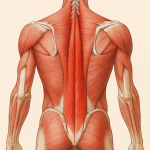
Where the Muscle Is Located
The erector spinae is a group of muscles and tendons that run vertically along both sides of the spine, from the lower back (sacrum and iliac crest) up to the base of the skull. It consists of three major columns:
- Iliocostalis (outermost)
- Longissimus (middle)
- Spinalis (innermost)
These muscles are responsible for spinal extension, lateral flexion, and rotation, playing a central role in maintaining an upright posture and controlling spinal movements.
Different Ways to Engage
- Superman Hold: Lie face down and lift your chest and legs off the ground, arching your back while keeping arms and legs extended.
- Back Extensions: Using a Roman chair or stability ball, lower your torso and then extend it upward, contracting through the lower back.
- Isometric Arch Hold: Stand or kneel and arch the upper body backward slightly while bracing the glutes and core. Hold the position without overextending the neck.
- Deadlifts with Isometric Pause: During a deadlift or hip hinge, pause at the top and hold full spinal extension with proper alignment.
- Bird-Dog with Spinal Focus: Extend one arm and the opposite leg from an all-fours position while focusing on keeping the spine long and the back engaged.
How Long to Hold Flex for Muscle Growth
- Beginner: 5–8 seconds per hold, 2–3 sets
- Intermediate: 10–15 seconds, 3–4 sets
- Advanced: 20–30 seconds with added load or tension, 4–5 sets
Train the erector spinae 2–4 times per week, depending on volume and intensity, as they are postural muscles that benefit from both endurance and strength work.
Different Levels of Skill
- Beginner: Focus on bodyweight holds like the superman or gentle arching movements with control and awareness.
- Intermediate: Introduce loaded back extensions or tempo deadlifts with emphasis on maintaining spinal alignment.
- Advanced: Incorporate compound lifts, isometric holds under load, and advanced stability drills like single-leg Romanian deadlifts or kettlebell carries.
How It Supports Other Muscles
- Gluteus Maximus and Hamstrings: Collaborates during hip extension and lifting movements.
- Latissimus Dorsi and Trapezius: Works in tandem during posture stabilization and pulling exercises.
- Rectus Abdominis and Obliques: Acts as an antagonist for balanced trunk flexion and extension control.
- Multifidus and Deep Core Muscles: Shares the role of segmental spine stabilization and injury prevention.
The erector spinae is essential for spinal health, posture, and nearly all compound lifting movements. Strengthening it improves resilience against back injury, enhances core function, and enables more powerful, stable movement throughout the body.
