

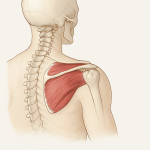
Where the Muscle Is Located
The infraspinatus is one of the four rotator cuff muscles. It is located on the back of the scapula, specifically in the infraspinous fossa (the broad surface below the spine of the scapula). It attaches to the greater tubercle of the humerus. The primary role of the infraspinatus is external (lateral) rotation of the shoulder and stabilization of the shoulder joint.
Different Ways to Engage
- External Rotation with Band: Attach a resistance band to a stable object at waist height. Keep your elbow at a 90-degree angle tucked close to your side and rotate your forearm outward against the band’s resistance.
- Side-Lying External Rotation: Lie on your side with a light dumbbell and rotate your arm outward from the torso while keeping your elbow pinned to your side.
- Isometric External Rotation Press: Push the back of your hand into an immovable surface like a wall while keeping your elbow at your side.
- Face Pulls with External Rotation: Using a rope attachment on a cable machine, pull toward your face with external rotation at the end of the movement.
- Towel Squeeze Drill: Place a rolled towel between your elbow and torso during external rotation exercises to keep proper elbow position and isolate the infraspinatus better.
How Long to Hold Flex for Muscle Growth
- Beginner: 5–8 seconds per hold, 2–3 sets
- Intermediate: 10–15 seconds, 3–4 sets
- Advanced: 20–30 seconds with tension or sustained motion, 4–5 sets
Train 3–5 times per week with low to moderate resistance, as rotator cuff muscles respond best to frequent but controlled stimulation.
Different Levels of Skill
- Beginner: Focus on light isometric holds and very controlled external rotation without added resistance.
- Intermediate: Introduce elastic bands or light dumbbells, maintaining strict elbow and shoulder positioning.
- Advanced: Perform complex stability drills, like external rotations combined with arm elevation, or integrate into athletic movement patterns.
How It Supports Other Muscles
- Supraspinatus: Works together to stabilize the shoulder during abduction.
- Teres Minor: Assists in external rotation and shoulder stability.
- Subscapularis: Balances the shoulder by opposing internal rotation forces.
- Deltoid (Posterior Fibers): Complements external rotation during arm lifting and reaching motions.
The infraspinatus plays a critical role in shoulder health, particularly for activities requiring overhead, throwing, or reaching motions. Strengthening it helps prevent rotator cuff injuries, improves posture, and ensures more efficient and safe arm and shoulder movements.
