
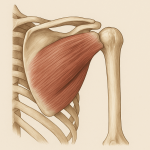
Where the Muscle Is Located
The teres major is a thick, rounded muscle located on the underside of the upper arm, just below the shoulder. It originates on the inferior angle of the scapula and inserts into the medial lip of the intertubercular groove of the humerus. Its main functions are adduction, internal rotation, and extension of the humerus at the shoulder joint.
Different Ways to Engage
- Band Arm Adduction: Anchor a resistance band to the side, and pull your straight arm toward your torso, activating the teres major as you adduct.
- Straight-Arm Pulldown: Using a resistance band or cable machine, pull your arms down from an overhead position toward your sides while keeping the elbows straight.
- Isometric Arm Press: Stand with your arm against a wall and press inward, holding tension in the shoulder and upper arm.
- Dumbbell Side Hold: Hold a dumbbell at your side with a slight backward pull, engaging the teres major through tension.
- Overhead Extension and Pull: Lift both arms overhead and then slowly pull them down in a “W” shape, keeping tension in the upper back.
How Long to Hold Flex for Muscle Growth
- Beginner: 5–8 seconds per hold, 2–3 sets
- Intermediate: 10–15 seconds, 3–4 sets
- Advanced: 20–30 seconds with resistance or increased time-under-tension, 4–5 sets
Train 2–3 times per week to allow recovery while promoting strength and stability in shoulder movements.
Different Levels of Skill
- Beginner: Learn to isolate the movement with light resistance and controlled adduction.
- Intermediate: Add resistance bands or small weights, focusing on control and scapular stability.
- Advanced: Combine with compound movements like pull-ups or rows, maintaining focus on the lower scapular contribution.
How It Supports Other Muscles
- Latissimus Dorsi: Often referred to as the “lat’s little helper,” the teres major works closely with the lat in shoulder adduction and internal rotation.
- Subscapularis: Supports shoulder rotation alongside this rotator cuff muscle.
- Pectoralis Major: Assists in shoulder adduction and internal rotation.
- Triceps (Long Head): Coordinates during pulling or extending movements involving the shoulder joint.
The teres major is a small but powerful muscle essential for shoulder control, especially during pulling and rotational tasks. Strengthening it improves upper-body function, enhances shoulder stability, and supports more efficient, safer movement patterns in sports and daily activity.


