
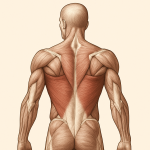
Where the Muscle Is Located
The latissimus dorsi is the broad, flat muscle that covers much of the middle and lower back. It originates from the lower thoracic and lumbar vertebrae, the sacrum, the iliac crest of the pelvis, and the lower ribs, and it inserts onto the intertubercular groove of the humerus (upper arm bone). Its primary actions are arm extension, adduction, and internal rotation of the shoulder.
Different Ways to Engage
- Lat Pulldown Hold: Perform a lat pulldown and hold the bar just below chin level while squeezing the lats and pulling the elbows down and back.
- Straight Arm Pulldown: Using a resistance band or cable, pull your arms from an overhead position down to your sides while keeping the elbows straight.
- Dead Hang Activation: Hang from a pull-up bar and slightly retract the scapulae without bending the elbows to engage the lats.
- Isometric Row Hold: Perform a rowing motion and hold the contraction at the point where your elbows are pulled back tight.
- Overhead Band Stretch and Pull: Anchor a resistance band above head height, grab the band, and pull your arms downward to mimic the motion of lat engagement.
How Long to Hold Flex for Muscle Growth
- Beginner: 5–8 seconds, 2–3 sets
- Intermediate: 10–15 seconds, 3–4 sets
- Advanced: 20–30 seconds with strong activation or resistance, 4–5 sets
Train the lats 2–3 times per week with a focus on full range and strong contraction to maximize development.
Different Levels of Skill
- Beginner: Focus on feeling lat activation during simple pulldown motions with light resistance.
- Intermediate: Introduce moderate load in exercises like banded pulldowns and partial pull-ups, emphasizing strict form.
- Advanced: Incorporate weighted pull-ups, heavy straight-arm pulldowns, and dynamic overhead movements with strong lat engagement.
How It Supports Other Muscles
- Teres Major: Assists the latissimus dorsi in shoulder extension and internal rotation.
- Posterior Deltoid: Works during arm extension and backward motion.
- Trapezius and Rhomboids: Support scapular stability during lat-dominant pulling movements.
- Core Muscles: The lats contribute to trunk stability, especially during heavy lifting or pulling motions.
The latissimus dorsi is critical for upper body pulling strength, spinal support, and overall athletic performance. Strong lats improve posture, enhance shoulder stability, and contribute to powerful motions like pulling, climbing, and swimming.


