
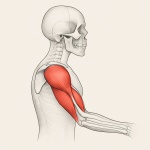
The biceps brachii is located on the front of the upper arm between the shoulder and the elbow. It is a two-headed muscle that crosses both the shoulder and elbow joints, making it responsible for both elbow flexion and assisting in shoulder movements.
Different Ways to Engage the Biceps Brachii
The most basic way to engage the biceps is to bend your elbow, bringing your forearm towards your shoulder. This can be done with or without resistance. Dumbbell curls, barbell curls, resistance band curls, and chin-ups are all ways to actively target the biceps. More advanced methods include concentration curls, preacher curls, and isometric holds under tension.
Where the Muscle Is Located
The biceps brachii runs from the scapula (shoulder blade) to the radius (one of the two forearm bones). It has two heads: the short head and the long head. Both heads originate at the scapula but converge to form a single muscle belly that attaches to the forearm, allowing it to perform flexion at the elbow and assist in shoulder stabilization.
How Long to Hold Flex for Muscle Growth at Different Skill Levels
- Beginners: Hold a flexed position for 5–10 seconds during isolated exercises to build basic muscle control.
- Intermediate: Increase hold times to 10–20 seconds to further fatigue the muscle and stimulate growth.
- Advanced: Hold flexed positions for 20–30 seconds or incorporate slow eccentrics (slowly lowering the weight) for maximal tension and hypertrophy benefits.
How the Biceps Brachii Supports Other Muscles
The biceps assist the brachialis and brachioradialis in elbow flexion, helping distribute the workload during pulling motions. They also support shoulder muscles such as the anterior deltoid when raising the arm and help stabilize the shoulder joint during dynamic upper body movements like throwing or lifting. A strong biceps brachii reduces strain on the forearms and shoulders during heavy lifts, enhancing overall upper body strength and coordination.


