
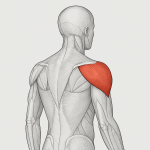
Where the Muscle Is Located
The deltoid is the rounded, triangular muscle that caps the shoulder. It originates from the clavicle (collarbone), acromion, and spine of the scapula, and inserts onto the deltoid tuberosity of the humerus. It has three distinct portions:
- Anterior (front): flexes and internally rotates the shoulder
- Lateral (middle): abducts the arm
- Posterior (rear): extends and externally rotates the shoulder
Together, the deltoid allows a wide range of arm movements and plays a central role in upper-body mobility.
Different Ways to Engage
- Side Arm Raise Hold: Raise your arm laterally to shoulder height and hold the position, targeting the middle deltoid.
- Front Raise Hold: Lift your arm forward to shoulder height to engage the anterior deltoid.
- Rear Fly Isometric: Bend at the waist and extend both arms backward while squeezing the shoulder blades together to activate the posterior deltoid.
- Wall Press Abduction: Stand sideways next to a wall and press your arm into the wall, maintaining a 90-degree angle.
- Band Lateral Raise: Step on a resistance band and raise your arm out to the side slowly and under control.
How Long to Hold Flex for Muscle Growth
- Beginner: 5–8 seconds per hold, 2–3 sets
- Intermediate: 10–15 seconds, 3–4 sets
- Advanced: 20–30 seconds with resistance or added load, 4–5 sets
Perform deltoid engagement exercises 2–3 times per week, allowing for recovery between sessions.
Different Levels of Skill
- Beginner: Use light isometrics and bodyweight holds to build awareness and coordination.
- Intermediate: Introduce resistance bands or light dumbbells to develop strength and endurance.
- Advanced: Perform isolated holds under load and integrate deltoid activation into compound upper body movements such as overhead presses or push-up variations.
How It Supports Other Muscles
- Rotator Cuff Muscles: The deltoid works alongside these smaller muscles to stabilize the shoulder joint.
- Trapezius: Supports shoulder elevation and retraction during arm movement.
- Serratus Anterior: Assists in scapular rotation and stabilization, especially during overhead motion.
- Pectoralis Major and Latissimus Dorsi: The deltoid balances anterior and posterior shoulder forces during pushing and pulling exercises.
The deltoid is essential for controlled, powerful arm motion in virtually all directions. Strengthening and isolating each portion of the deltoid ensures shoulder integrity, improves upper-body aesthetics, and supports daily function and athletic performance.


