
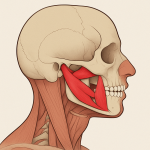
Where the Muscle Is Located
The pterygoid muscles are two paired muscles found deep within the face, on each side of the jaw:
- Medial Pterygoid: Runs from the pterygoid fossa (inside the skull) to the inner surface of the mandible. It elevates the jaw and helps with side-to-side grinding.
- Lateral Pterygoid: Has two heads (upper and lower) and runs from the sphenoid bone to the condyle of the mandible and the TMJ disc. It helps lower and protrude the jaw and also assists in side-to-side motion.
These muscles work together to move the jaw in complex ways, especially during chewing and grinding.
Different Ways to Engage
- Jaw Side Shift: Move your jaw slowly from side to side, keeping your head still.
- Protrusion Push: Push your lower jaw forward and hold it while resisting the motion gently with your hand.
- Open-Clench Combo: Slowly open and close your mouth while shifting side-to-side to activate both medial and lateral fibers.
- Chew Simulation: Mimic the motion of chewing tough food with controlled pressure and resistance.
- Isometric Side Press: Press your lower jaw sideways against resistance (like a palm) without actually moving it.
How Long to Hold Flex for Muscle Growth
- Beginner: 5–10 seconds per hold, 2–3 sets
- Intermediate: 10–15 seconds, 3–4 sets
- Advanced: 20–30 seconds with resistance, 5 sets
Perform exercises 2–3 times a week, avoiding overuse to prevent TMJ strain or imbalance.
Different Levels of Skill
- Beginner: Learn jaw awareness and controlled side-to-side motion without involving the neck.
- Intermediate: Add resistance and work on symmetry and coordination of both sides.
- Advanced: Incorporate full jaw rotation patterns, resistance training, and stabilization drills with timing control.
How It Supports Other Muscles
- Masseter and Temporalis: The pterygoids assist in elevating, protruding, and grinding motions alongside these jaw-closing muscles.
- Digastric and Mylohyoid Muscles: Coordinate with pterygoids during jaw opening and speech.
- Neck Muscles: Help stabilize the head during jaw movement.
- Facial Muscles: Provide foundational motion that enhances chewing and expression movements.
The pterygoid muscles are essential for jaw mechanics, chewing, and functional stability of the temporomandibular joint. Strengthening them can help improve bite force, reduce jaw imbalances, and prevent TMJ dysfunction when trained mindfully and progressively.


