
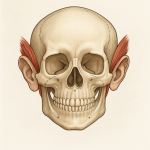
Where the Muscle Is Located
The auricular muscles are a group of three small muscles surrounding the ear:
- Anterior Auricular: Located in front of the ear, connects the temporal region of the skull to the ear.
- Superior Auricular: Situated above the ear, the largest of the three, stretching from the scalp to the upper part of the ear.
- Posterior Auricular: Behind the ear, running from the mastoid process (part of the skull) to the back of the ear.
These muscles are generally underdeveloped in most people, but they control subtle ear movements like twitching, raising, or pulling the ears back.
Different Ways to Engage
- Ear Raise Attempt: Focus on lifting the ears upward without moving the jaw or eyebrows.
- Forward Twitch Practice: Isolate the anterior auricular by trying to pull your ears forward while keeping your face still.
- Backward Glide: Draw your ears slightly backward using only the muscles behind them.
- Mirror Focus Training: Use a mirror and slow motion to learn how to isolate one ear or muscle at a time.
- Tactile Feedback Method: Lightly place fingers near the ear while trying to move it, feeling for muscle activation.
How Long to Hold Flex for Muscle Growth
- Beginner: 3–5 seconds per movement, 3 sets
- Intermediate: 5–10 seconds, 4 sets
- Advanced: 10–15 seconds with repeated directional holds, 5+ sets
Practice consistently, 3–5 times per week. These muscles often take longer to control and develop due to lack of natural use.
Different Levels of Skill
- Beginner: Gaining awareness of ear muscles and learning to create even the slightest movement.
- Intermediate: Achieving basic ear motion in one or more directions with minimal assistance from surrounding muscles.
- Advanced: Isolating each auricular muscle independently and incorporating movement patterns or alternating controls.
How It Supports Other Muscles
- Temporalis: Works in coordination for scalp and side-of-head tension adjustments.
- Occipitofrontalis: Connects via the epicranial aponeurosis for coordinated scalp movement.
- Facial Muscles: Subtly involved in expressions of curiosity or surprise when ear movement is used expressively.
- Neck Stabilizers: Posterior auricular muscle tension can engage neck muscles for head posture or reactionary movements.
Training the auricular muscles is a unique and often overlooked part of facial control. While not critical to daily function, developing them enhances muscle coordination, scalp tension control, and can improve awareness of head-and-neck muscular interplay.


